
The Best Personality Tests in 2026, Ranked and Compared
We compared the best personality tests of 2026 on accuracy, price and what you get for free, from Big Five and MBTI to Enneagram, DISC and HEXACO.

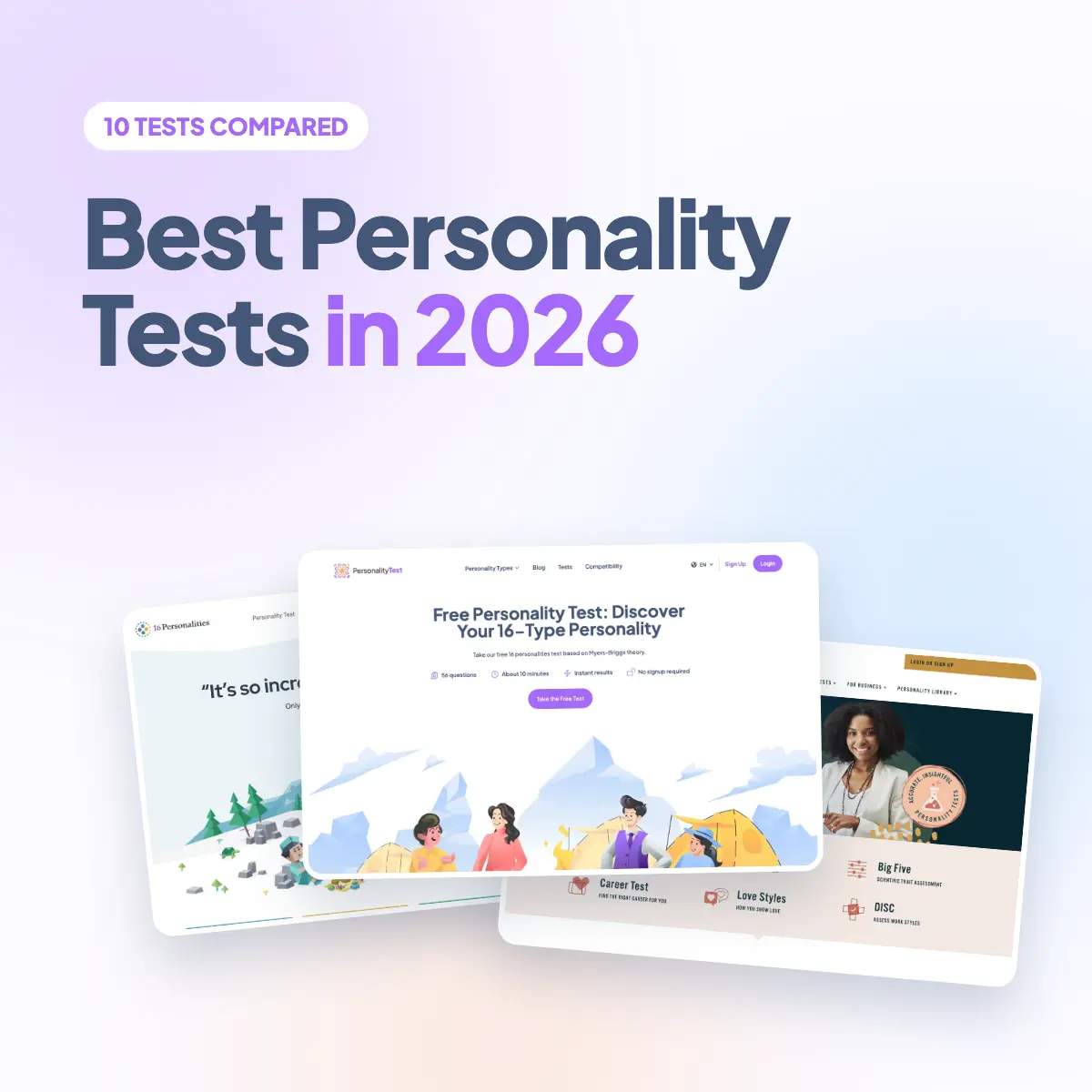
Short version: if you want lots of frameworks in one place, start with PersonalityTest. If you want a free 16-type result with no signup, take 16Personalities. If you want the most research-standard free option, take the IPIP Big Five at Open Psychometrics. If you need the official MBTI, you have to pay for MBTIonline.
This guide is published by the PersonalityTest team, so we put our own tool first and then compare everyone else as honestly as we can.
Everything below was checked on each site on October 30, 2026: question counts, time, what you actually get for free, what it costs, and whether you need to sign up. Prices change, so treat them as a snapshot.
Quick picks
- Best for many frameworks in one place: PersonalityTest, 28 tests under one account
- Best free with no signup: 16Personalities
- Best official MBTI: MBTIonline
- Best science-based Big Five: Open Psychometrics IPIP Big Five
- Best for strengths at work: Gallup CliftonStrengths
- Best Enneagram: The Enneagram Institute RHETI (Truity's Enneagram test if you want a free start)
The best personality tests at a glance
| Tool | Framework | Questions | Time | What is free | Paid price | Signup needed |
|---|---|---|---|---|---|---|
PersonalityTest | 28 tests: 16-type, Big Five, HEXACO, Enneagram, DISC and more | 16 to 100 depending on the test (56 for the 16-type test) | 5 to 20 min per test (site estimates) | Taking every test; a basic result on 6 lighter quizzes; full results free if 2 invited friends finish a test | $2.95 for a 7-day trial, then $29.99/month unless canceled | Free account to see results |
16Personalities | Own NERIS model, 16 types + Assertive/Turbulent | 60 | About 10 min | Full type description | Premium Career Suite: 29 € when we checked from Europe; USD price not verified | Xeyr |
Truity TypeFinder | Myers-Briggs style 16 types + 23 facets | 130 | 10 to 15 min | Brief report | Full report $29 | Xeyr |
Open Psychometrics IPIP Big Five | Big Five | 50 | 3 to 8 min | Everything | Nothing to buy | Xeyr |
MBTIonline | Official MBTI | Not stated | About 45 min incl. type verification | Nothing | $59.95 (Careers $79.95) | Yes, paid account |
Gallup CliftonStrengths | 34 talent themes | About 200 timed paired statements | 30 min | Nothing | Top 5 $24.99; all 34 $59.99 | Bəli |
VIA Survey | 24 character strengths | 96 (English version) | 10 to 15 min | Ranked list of all 24 strengths | Top 5 Report $19; Total 24 $49 | Yes, email before starting |
Enneagram Institute RHETI | Enneagram, 9 types | 144 paired statements | About 40 min | Nothing | $20 per test; $36 with the IVQ | Purchase required |
Crystal | DISC, 16 archetypes | 28 | 5 dəq | DISC result | Premium $49/month or $490/year | Free account at the end |
HIGH5 | Strengths, top 5 shown | 120 | 15 to 20 min | Top 5 strengths | Reports $29 each; Pro $96/year | Yes, before the test |
How we ranked them
We looked at six things: how solid the framework is, how open the publisher is about its evidence, what you get without paying, how deep the full report goes, how many languages it covers, and how much friction there is (signups, timers, upsells).
No single test wins on all six. The Big Five is the strongest framework scientifically, but the free Big Five tests give you very little interpretation. The official MBTI has decades of publisher research but costs $59.95 and is criticized by academic psychologists. So the ranking is about which tool is most useful for most people, and each section says who should skip it.
The 10 best personality tests in 2026
#1. PersonalityTest: best for trying many frameworks in one place

What it measures: PersonalityTest has 28 tests, from the 16-type test, Big Five, HEXACO, Enneagram and DISC to attachment style, love languages and a few just-for-fun quizzes. The 16-type personality test has 56 questions on a 5-point agree/disagree scale and takes about 10 minutes. It is built on the same Jung, Briggs and Myers framework, but it is an independent test, not the official MBTI, and the site says so on the test page. The Big Five test has 60 questions, the HEXACO test has 30, the Enneagram test has 63 and the DISC test has 40.
Free vs paid: Every test is free to take, with no account and no payment to start. To see your results on most tests (22 of the 28), you create a free account and then either start a $2.95 7-day trial that continues at $29.99 a month unless you cancel, or unlock your full results for free by inviting 2 friends who each finish a test. Six lighter quizzes, including the career test, show a basic result with just the free account. One subscription covers full reports for every test, and canceling during the trial means no further charge.
Why it is #1: Breadth under one account. You can take the 16-type test, then the Big Five and HEXACO to see how a trait model describes you, then attachment style or love languages for the relationship side, and your results are saved in one profile. The site runs in 15 languages. The free uyğunluq kalkulyatoru lets you check any two of the 16 types, with a clickable 16x16 chart and 136 pair guides, and the personality type library has free profiles for all 16 types, grouped into Analysts, Diplomats, Sentinels and Explorers. Subscribers also get a "Dimension trends" chart that tracks how your 16-type scores shift across retakes, plus PDF reports for the 16-type and Enneagram results. As of October 2026, more than 5,300 tests have been taken across 139 countries.
Best for: People who want to compare several frameworks side by side and keep the results in one place, especially if they care about relationships as well as type.
Honest drawbacks: On the 22 core tests there is no free preview of your type or scores; you see nothing until you pay or your invites land. It is a monthly subscription, not a one-time fee, and canceling is done by email or a request form rather than a button. None of the tests are published, peer-reviewed instruments, and the site does not publish reliability or validity statistics. It is also a young site: some tests have fewer than 50 completions, and test content in languages other than English is machine translated.
#2. 16Personalities: best free test with no signup

What it measures: 16Personalities uses its own model, the NERIS Type Explorer, with five scales: Energy, Mind, Nature, Tactics and Identity. The letters look like Myers-Briggs codes, plus an extra Assertive/Turbulent letter. It is not the MBTI. In the company's own words, it uses "the NERIS Type Explorer framework, including the Assertive-Turbulent Identity scale, and does not use Jungian cognitive function stacks." Instead, it says it reworked the Big Five traits. The test has 60 questions and takes about 10 minutes.
Free vs paid: The test and the full type description are free. You don't need to register. The paid Premium Career Suite (a 40+ page career guide with a 30-day money-back guarantee) showed as 29 € when we checked from Europe; the US dollar price wasn't shown to us.
Best for: A fast, polished 16-type profile in your own language. It lists 49 language options, and the homepage counter claimed more than 1.59 billion tests taken.
Honest drawbacks: Because it borrows MBTI-style letters, people often confuse it with the official MBTI. It publishes reliability figures (Cronbach's alpha between 0.75 and 0.87 across its scales), but on its own site rather than in a journal. Deeper career and relationship content is behind the paid suite.
#3. Truity: best for a free start across three frameworks

What it measures: Truity offers a 16-type test (TypeFinder), a Big Five test and an Enneagram test, among others. TypeFinder covers the four Myers-Briggs dimensions plus 23 more detailed facets, with 130 questions in about 10 to 15 minutes. The Big Five test is 60 questions in about 5 to 10 minutes, and the Enneagram test is about 105 questions in 10 to 15 minutes. Truity says more than 50 million people have taken its tests.
Free vs paid: You can take each test and see an overview of your results without registering. The full TypeFinder and Big Five reports cost $29 each (23 and 17 page PDFs), with a 60-day money-back guarantee. The Enneagram test shows free scores for all nine types, with a full report "for a fee".
Best for: Trying three of the major frameworks for free, with the option of a detailed paid report on one.
Honest drawbacks: The free result is brief, and the $29 price only appears at checkout, after you finish. Free results are deleted after 14 days unless you register or buy. The site carries ads. Credit where due, though: TypeFinder is one of the few online tests with public technical documentation on reliability and validity, and Truity openly says it is not the MBTI and has no affiliation with its publisher.
#4. Open Psychometrics IPIP Big Five: best science-based free test

What it measures:Open-Source Psychometrics Project runs a Big Five test using the IPIP Big-Five Factor Markers, public-domain items from the International Personality Item Pool based on Goldberg's 1992 Big Five markers. It is 50 items on a five-point scale and takes most people 3 to 8 minutes.
Free vs paid: Completely free. No account, nothing to buy. Responses are recorded anonymously and may be used for research; the project says its data has been used in 25+ journal articles.
Best for: Skeptics who want a quick, research-standard Big Five score with zero sales funnel.
Honest drawbacks: You get five scores and not much else: no types, career advice or relationship guidance. The design is plain and the test page was last updated in 2019. The site itself says results are for educational or entertainment purposes and come with no guarantee of accuracy.
#5. MBTIonline: best official MBTI

What it measures: MBTIonline is run by The Myers-Briggs Company and gives you the official Myers-Briggs Type Indicator: four preference pairs, 16 types. According to the publisher, the only ways to take the real MBTI online are MBTIonline, a certified practitioner, or your organization or school.
Free vs paid: There is no free version. The personal edition is $59.95 and includes the assessment, an individual report, action guides with a comparison tool, and short courses. MBTIonline Careers is $79.95, and the Teams edition is $99.95 per participant. You need a paid account.
Best for: People who specifically want the official, licensed MBTI result, for example to match what a coach or employer uses.
Honest drawbacks: At $59.95 it is one of the priciest options here, and the assessment plus "best-fit" type verification takes about 45 minutes. The publisher itself says the MBTI is not intended for hiring or team assignments. And the type model draws heavy criticism in academic psychology (more on that in the frameworks section below).
#6. Gallup CliftonStrengths: best for strengths at work

What it measures: CliftonStrengths sorts your talents into 34 themes. You see about 200 paired statements and pick which one describes you better, with 20 seconds per item, in about 30 minutes. It is available in 30 languages, and Gallup's counter shows more than 38 million people using it.
Free vs paid: Nothing is free. Top 5 costs $24.99, the full ranking of all 34 themes costs $59.99, and you can upgrade from Top 5 to 34 for $49.99. You buy a code, sign in and redeem it.
Best for: Professionals and teams who want a shared, practical strengths vocabulary for work and development.
Honest drawbacks: No free tier, and the 20-second timer isn't for everyone. It ranks themes within you rather than comparing you with other people, so it is a development tool, not a full personality profile. Gallup reports retest coefficients above 0.70 over six months, but most of the published evidence comes from Gallup's own research.
#7. VIA Character Strengths Survey: best free strengths test

What it measures:VIA Survey ranks 24 character strengths from positive psychology. It was developed by psychologist Christopher Peterson and revised by Robert McGrath. The current English version has 96 questions and takes about 10 to 15 minutes; most other languages still use the older 120-question version. VIA says it is offered in 46 languages.
Free vs paid: You get a free ranked list of all 24 strengths. Explanations cost extra: the Top 5 Report is $19 and the Total 24 report is $49.
Best for: A free, research-backed look at your positive strengths, especially for wellbeing or coaching.
Honest drawbacks: You have to give your email before you start. The free result is a bare ranked list without raw scores. And it measures character strengths, not your overall personality, so it works alongside a Big Five or 16-type test rather than replacing one.
#8. The Enneagram Institute RHETI: best Enneagram test

What it measures:RHETI (Riso-Hudson Enneagram Type Indicator, version 2.5) is the Enneagram Institute's own test. It is forced choice: 144 paired statements, about 40 minutes. Results come by email as a PDF with your scores for all nine types and expanded descriptions (over 2,500 words each) of your top three.
Free vs paid: No free version. A test code is $20, and the bundle with the Instinctual Variant Questionnaire is $36. It is a one-time purchase with no subscription. Codes are single-use and expire a year after purchase.
Best for: Enneagram fans who want the institute's own test and a full nine-type score profile. If you'd rather start free, Truity's Enneagram test is shorter and shows free scores for all nine types.
Honest drawbacks: It is long, there is no free result, the order form only showed English, and the site feels dated. The institute calls RHETI "independently scientifically validated" but gives no citation on that page, and Truity points out that "there is no official Enneagram test".
#9. Crystal: best quick DISC test

What it measures: Crystal's DISC test scores you on Dominance, Influence, Steadiness and Conscientiousness and places you on a wheel of 16 archetypes. DISC goes back to William Moulton Marston's 1928 book Emotions of Normal People. It is 28 short questions and takes about five minutes, one of the quickest tests on this list.
Free vs paid: The test and DISC result are free, and Crystal says every assessment is free, as often as you like. You create a free account at the end to see your result. Crystal Premium is $49 a month or $490 a year.
Best for: Work communication and sales teams who want a quick DISC style and tips on how to talk with each type.
Honest drawbacks: You need an account to see results, and premium is a pricey subscription. Crystal also builds predicted DISC profiles of other people from publicly available data, such as LinkedIn profiles, and those people never took the test. Some readers will find that intrusive.
#10. HIGH5: best free alternative to CliftonStrengths

What it measures: HIGH5 is a strengths test with 120 untimed questions in about 15 to 20 minutes. It recommends test takers be at least 16 and claims more than 4 million test takers.
Free vs paid: The free plan shows your top 5 strengths with definitions. Personal, Career and Student reports are $29 each, and HIGH5 Pro is $96 a year.
Best for: A free CliftonStrengths-style top 5 for individuals and teams on a budget.
Honest drawbacks: You must sign up before you start. HIGH5 calls itself "scientifically validated", but its validation is self-published and we saw no peer-reviewed citation.
We also looked at PersonalityPerfect and MyPersonality, two free 16-type style tests, but the newest dated content we found on either site was from 2024, so they didn't make the list.
Personality test frameworks explained
Most of the confusion around personality tests comes from mixing up the website with the framework underneath it. Here is how the main ones differ, and how much science backs each.
MBTI-style types (16 types)
These tests sort you into one of 16 four-letter types based on preferences such as introversion vs extraversion. They are easy to remember and fun to talk about, which is why they are the most popular. The official version is the MBTI; 16Personalities, Truity's TypeFinder and our 16-type test are independent tests built on similar ideas. If you want the theory behind the letters, our cognitive functions guide explains the Jungian side.
The science is where it gets shaky. A 2019 review by Stein and Swan found that "the MBTI theory falters on rigorous theoretical criteria in that it lacks agreement with known facts and data, lacks testability, and possesses internal contradictions." Pittenger (2005) published cautionary comments on the MBTI in a consulting psychology journal. A widely shared Vox piece said "as many as 50 percent of people arrive at a different result the second time they take a test."
To be fair to the publisher: The Myers-Briggs Company responds that the 50 percent figure traces back to a 1979 study of an obsolete form of the test, and reports test-retest correlations of 0.81 to 0.86 for the current version over 6 to 15 weeks. Even Truity notes that the MBTI "has been criticized for its validity, specifically compared to the more robust Big Five model, and it is rarely used in academic research." Our take: type tests are a good conversation starter, not a verdict.
Big Five (OCEAN) and HEXACO
The Big Five measures five traits on a scale instead of putting you in a box: openness, conscientiousness, extraversion, agreeableness and neuroticism. According to the Open-Source Psychometrics Project, it is "the best accepted and most commonly used model of personality in academic psychology." If you only take one test for accuracy, take a Big Five test.
HEXACO is a related six-factor trait model. If you've already done the Big Five, our HEXACO test is a good next step to compare.
Enneagram
The Enneagram sorts people into nine types, with secondary ideas like wings and movement between types. The evidence is mixed: a 2021 systematic review by Hook and colleagues of 104 samples found "mixed evidence of reliability and validity," noted that factor analyses "typically found fewer than nine factors," and found little research supporting wings and movement between types.
DISC
DISC sorts workplace behavior into four styles: Dominance, Influence, Steadiness and Conscientiousness. It is popular in business for communication and sales training. It is less studied in academic personality research than the Big Five, so treat it as a practical workplace tool rather than a full picture of your personality.
Strengths tests (CliftonStrengths, VIA, HIGH5)
Strengths tests don't try to describe your whole personality. They rank what you're naturally good at so you can use it more. CliftonStrengths has a large research program, but most of it is published by Gallup itself. VIA comes from positive psychology; its 24 strengths were originally grouped into six virtues, but VIA's own senior scientist has reported a three-factor structure instead. HIGH5's evidence is self-published.
Which personality test is the most accurate?
For measuring personality in general, a Big Five test has the strongest backing in academic research. Beyond that, "accurate" depends on what you want: a strengths test can be very useful for work without being a full personality model. Whatever you take, remember it is a self-report questionnaire. It reflects how you see yourself, so answer as you actually are, not as you'd like to be.
Which test should you take?
For self-understanding: Start with a Big Five test for a trait-based baseline, either the free IPIP version at Open Psychometrics or our Big Five test (free to take; full results need the trial or two invites). Then take a 16-type test if you want a more memorable label to explore. Comparing the two is often more revealing than either one alone.
For career: A strengths test (CliftonStrengths if you'll pay, VIA or HIGH5 if you won't) gives you language for what you're good at. For choosing a direction, our career test uses Holland Codes (RIASEC) and shows a basic result with a free account. MBTIonline Careers is the official option if you specifically want MBTI-based career guidance.
For relationships: Type-based tools are useful here mostly as a way to talk about differences. Try our bağlanma üslubu testi və sevgi dili testi, or the couples compatibility test together with your partner. Our free compatibility calculator lets you compare any two of the 16 types.
For teams and work: Crystal's DISC test is quick and gives practical tips for communicating with each style. CliftonStrengths is the established choice for team development. Note that the MBTI publisher says its test is not meant for hiring or team assignments, which is a good rule for any personality test: use them for conversation, not selection.
Just for fun: Plenty of tests are entertainment, including some of ours (like the Hogwarts House quiz). That's fine, as long as you don't treat them as assessments.
Ready to try one? You can take the free personality test on our site, no account needed to start.

Olivia Grant psixologiya və şəxsi inkişaf üçün rəqəmsal alətlər üzrə ixtisaslaşmış məhsul meneceridir. O, platformanın xüsusiyyətlərinin - şəxsiyyət testlərindən interaktiv məlumatlara qədər - istifadəçi dostu, etibarlı və həm tədqiqat, həm də istifadəçi tələbləri ilə uyğun olmasını təmin edir. Psixologiya və texnologiya məhsul idarəçiliyi sahəsindəki təcrübəsi ilə Olivia dizayn, inkişaf və məzmun arasında körpü qurur, mürəkkəb alətləri hər kəs üçün əlçatan edir. İşdən kənarda, o, itiylə yürüyüş etməyi və yemək bişirməyi sevir.

Xəbər bülletenimizə abunə olun
Birbaşa gələn qutunuza göndərilən ən son xəbərlər, məsləhətlər və eksklüziv təkliflərlə yenilənmiş qalın.
Şəxsiyyət Testi ilə Bağlı Tez-tez Verilən Suallar
Which personality test is the most accurate?
A Big Five test has the strongest support in academic personality research. The free IPIP Big Five from the Open-Source Psychometrics Project uses public-domain research items. Type tests like the MBTI are more popular but more criticized, and all of these tests are self-report, so their accuracy depends on honest answers.
Is the MBTI test free?
No. The official MBTI is only available online through MBTIonline ($59.95), a certified practitioner, or your organization or school. 16-type tests that are free to take, like 16Personalities, Truity's TypeFinder and the PersonalityTest 16-type test, are independent tests built on similar ideas, not the official MBTI.
What is the best free personality test?
For a full free result with no signup, 16Personalities (16 types) and the Open Psychometrics IPIP Big Five (Big Five traits) are the best options. Truity also gives a brief free report without registering. On PersonalityTest, every test is free to take, but full results on most tests need a free account plus either the paid trial or two friends who finish a test from your invite link.
Are online personality tests reliable?
Some are more transparent than others. Truity and 16Personalities publish reliability data (16Personalities on its own site), and the MBTI and CliftonStrengths publishers report retest figures from their own research. Many sites, including ours, do not publish reliability or validity statistics. Treat any result as a starting point for reflection.
How long does a personality test take?
It ranges from about 3 to 8 minutes for the 50-item IPIP Big Five and 5 minutes for Crystal's DISC test to about 30 minutes for CliftonStrengths, 40 minutes for the RHETI and 45 minutes for MBTIonline with type verification. The other 16-type tests in this guide take about 10 to 15 minutes.
Can your personality type change?
Your result can change between attempts. Vox reported that up to half of people get a different MBTI type on a retake, though the publisher says that figure comes from an obsolete form and reports retest correlations of 0.81 to 0.86 for the current version. Gallup reports CliftonStrengths retest coefficients above 0.60 even after seven or more years. If you retake tests over time, saving your results lets you see what actually shifts.
Şəxsiyyət Tipinizi Tapmağa Hazırsınız?
On dəqiqə, 56 sual və düşüncə, iş və əlaqə tərzinizin arxasındakı səbəbləri izah edən bir hesabat.
Pulsuz, 15 dildə, qeydiyyat tələb olunmur.
Pulsuz Şəxsiyyət Testini Keçin